2024-03-19

The Great American Eclipse 2024

On 8 April 2024, people in North America can witness a once-in-a-life-time event. Total solar eclipses are the most spectacular predictable astronomical events. This wonder from the heavens greatly surpasses lunar eclipses, partial solar eclipses or even annular eclipses. I would only rank majestic comets, ultra-strong northern lights and extraordinary meteor showers (which have not occurred in my life time), which are all unpredictable, over total solar eclipses.

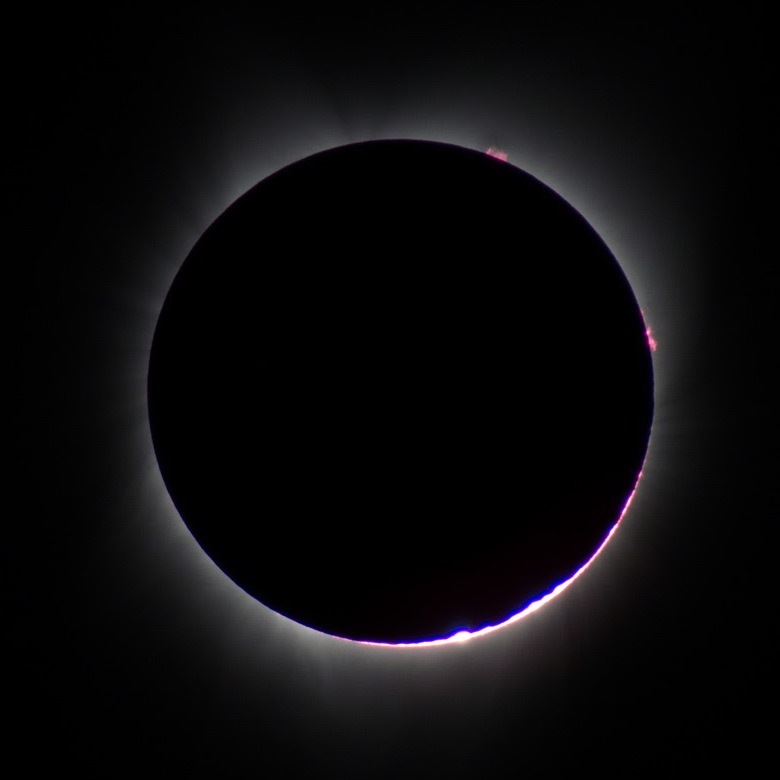
Total solar eclipse of 2017
© Gabriel Chow

Many amateur astronomers, including myself, would spend years of planning and may have to spend a fortune of money to get to a place in the hope of witnessing the event with favourable weather and cloud conditions. For instance, I flew to Idaho in 2017 and witnessed and photographed the memorable celestial event.

Catholic significance

For Roman Catholics, the Church will celebrate the Solemnity of the Annunciation of the Lord on 8 April in the year 2024. While the feast commemorating the incarnation of Christ is usually celebrated on 25 March, but since the day occurs in the Holy Week this year, it is transferred to the next unimpeded day: Monday after Divine Mercy Sunday. 

Solar eclipses used to be associated with disasters; having the incarnation of the Son (Sun) hidden (eclipsed) on that day may signify impending tribulations in the world. The occurrence of this eclipse with rare conditions on the Solemnity of the Annunciation may give an even greater symbolic meaning: will a world war break out any time soon? God may use signs to give us messages, but the faithful have nothing to fear if they trust in the Lord.

Where to see the total eclipse?

Virtually the whole North America can witness a partial eclipse on that day. However, only a small area, called the path of totality, can witness a total eclipse. The path is narrow (usually about 100km wide) and often falls on ocean or uninhabited lands. This total solar eclipse, however, is unmatched in recent history as the path of totality sweeps through many heavily populated areas in multiple states in North America: from Sinaloa, Durango and Coahuila in Mexico, to Texas, Arkansas, Missouri, Illinois, Kentucky, Indiana, Ohio, Michigan (barely touching), Pennsylvania, New York, Vermont, New Hampshire and Maine in USA, and finally to Canada in the provinces of Ontario, Quebec, New Brunswick, Prince Edward Island, Nova Scotia (barely touching) and Newfoundland.

Major cities in Mexico that lie in the path of totality include Mazatlán, Durango, Torreón, Gómez Palacio and Piedras Negras. For USA, the entire major cities of Austin, San Antonio (half of it), Fort Worth, Dallas, Tyler, Little Rock, Evansville, Indianapolis, Dayton, Toledo, Cleveland, Erie, Buffalo, Rochester, Syracuse and Burlington will experience total darkness. In Canada, Hamilton, St. Catharines, Niagara Falls, Kingston, most of Montreal, Sherbrooke and Miramichi also fortunately lie on the path.

Churches that will see the total eclipse


For Catholics, you can watch the total eclipse from many churches that lie on a path of totality. Whereas I counted 744 churches for the total eclipse in 2017, this time the GCatholic database of churches lists 3,217 Catholic churches in North America that will fall on the path of totality. This great number gives a rough estimation of how many more people can see the total eclipse as compared to 2017 as the population roughly corresponds to the church density.

Around Lake Ontario
Fort Worth, Dallas
Montreal, Burlington, Sherbrooke

These represent churches from 60 different Roman Catholic dioceses, 8 from Mexico, 29 from USA and 21 from Canada. In particular, 36 Cathedrals fall on the path of totality, namely:

6 Cathedrals marked with * above are minor basilicas. 10 other basilicas will also witness the total eclipse:
Various former cathedrals are also on the path of totality: IndianapolisEvansville, Burlington, Beloeil, Hamilton, Montreal, St. Raphael, St. George's. Some noteworthy abbeys and monasteries include:
Cathedrals and Basilicas in the path of totality

If you live close to any of these churches, you won't regret travelling a bit to witness this heavenly event. Just make sure that you use proper eyewear protection and do not look directly at the sun before and after the 2 to 3 minutes of totality.

2020-03-16

Suspension of Masses for COVID-19

In an effort to contain the COVID-19 pandemic and for the health of the faithful, many dioceses have issued decrees to suspend the public celebration of masses. I will seek to summarize the decisions that have been made worldwide as well as recording the dates of the decrees. This post will be continually updated.

Many dioceses have dispensed the faithful from the obligation of attending Sunday masses, but these are not recorded in this post.

Judging from the observed trend, I fear that there will be no public celebration of the Triduum in the most populous places on earth. This would be unprecedented in the history of the Church.

Macau

  • (February 5) All liturgies are suspended until February 19. (February 16) All liturgies are suspended until March 6, and all churches must remain closed. (February 28) Some churches can open from March 7, but liturgies are still suspended.

Hong Kong

  •  (February 13) All liturgies are suspended from February 15 to 28. (February 25) All liturgies, except funerals and weddings, are suspended until further notice.

Singapore

  •  (February 14) All masses are suspended until further notice. (March 5) Masses will resume on March 14. (March 12) All masses are suspended until further notice.

    China

    •  (February 25) The government orders all churches to close and bans all religious activities.

    Netherlands

    • (February 28) Sunday masses are suspended. (March 18) All Holy Week and Easter liturgies are suspended.

    Italy

    • (March 8) All masses are suspended until April 3.

     Slovakia

    • (March 10) All masses are suspended until March 23.

      Philippines

      • Archdiocese of Manila: (March 13) All Sunday masses are suspended for March 13-14. (March 16) All masses are suspended until April 13.
      • Ecclesiastical province of Manila: (March 16) All masses are suspended until April 13.
      • Archdiocese of Capiz: (March 18) All masses are suspended until April 17.

      Canada

      • Province of Quebec: (March 13) All Sunday masses are suspended but churches could remain open for weekday masses and events such as weddings and funerals, provided there were fewer than 250 people in the church. (March 15) All masses are suspended.
      • Archdiocese of Toronto: (March 13) Sunday Masses are suspended at least for the weekend of March 14-15, but churches could remain open for private prayer and Eucharistic adoration. (March 17) All masses are suspended until further notice.
      • Archdiocese of Vancouver: (March 13) Masses must limit to 250 people. (March 14) The faithful are dispensed from Sunday obligations. (March 16) Masses must limit to 50 people. (March 20) All masses are suspended from March 21 until further notice.
      • Archdiocese of Moncton: (March 13): All masses are suspended until further notice.
      • Diocese of Hamilton: (March 16) All masses are suspended until further notice.
      • Diocese of St. Catharines: (March 16) Sunday masses are suspended until April 18.
      • Diocese of Thunder Bay: (March 16) Sunday masses are suspended until March 29.
      • Archdiocese of Halifax: (March 16) All masses are suspended until further notice.
      • Archdiocese of St. John's, Newfoundland: (March 16)  All masses, except funeral and wedding liturgies, are suspended from March 18 until further notice.
      • Diocese of Grand Falls: (March 16) All masses are suspended from March 17 until further notice.
      • Archdiocese of Grouard–McLennan: (March 16) All masses are suspended until further notice.
      • Diocese of St. Paul: (March 16) All masses, except funerals, are suspended until further notice.
      • Archdiocese of Kingston: (March 17) All masses, except private funerals, are suspended until further notice.
      • Diocese of Saint John: (March 17) All masses are suspended until further notice.
      • Diocese of Charlottetown: (March 17) All masses are suspended until further notice.
      • Diocese of London: (March 17) All masses are suspended until April 30.
      • Archdiocese of Ottawa: (March 17) All masses are suspended until April 5.
      • Diocese of Peterborough: (March 17) All masses, except funeral and wedding liturgies, are suspended until April 5.
      • Diocese of MacKenzie–Fort Smith: (March 17) Sunday masses are suspended until further notice.
      • Archdiocese of Edmonton: (March 17) All masses are suspended until further notice.
      • Diocese of Calgary: (March 17) All masses, except funerals, are suspended until April 5.
      • Diocese of Alexandria–Cornwall: (March 17) All masses are suspended until April 5.
      • Syro-Malankara Eparchy: (March 18) All liturgies are suspended until further notice.

      USA

      • Archdiocese of Seattle: (March 11) All masses are suspended until further notice.
      • Archdiocese of Chicago: (March 13) All masses are suspended until further notice.
      • Archdiocese of Boston: (March 13) All masses are suspended until further notice.
      • Diocese of San Jose: (March 13) All masses are suspended until further notice.
      • Archdiocese of Santa Fe: (March 13) All masses are suspended until further notice.
      • Archdiocese of New York: (March 13) The faithful are urged not to attend masses. (March 14) All Sunday masses are suspended for March 14-15, and churches can remain open for private prayers.
      • Archdiocese of San Antonio: (March 13) All Sunday masses are suspended for March 14-15.
      • Archdiocese of Newark: (March 13) All Sunday masses are suspended for March 14-15.
      • Diocese of Wheeling-Charleston: (March 13) All masses are suspended until further notice.
      • Archdiocese of Washington: (March 13) All masses are suspended until further notice.
      • Archdiocese of Denver: (March 13) All masses are suspended until further notice.
      • Diocese of Colorado Springs: (March 13) All masses are suspended until further notice.
      • Diocese of Pueblo: (March 13) All masses are suspended until further notice.
      • Archdiocese of Anchorage: (March 13) All masses are suspended until March 27.
      • Archdiocese of Juneau: (March 13) All masses are suspended until March 27.
      • Archdiocese of Santa Fe: (March 13) All masses are suspended until further notice.
      • Archdiocese of Baltimore: (March 14) All masses are suspended until further notice.
      • Diocese of Dallas: (March 14) All masses are suspended until March 30.
      • Archdiocese of Detroit: (March 14) All masses are suspended until April 5.
      • Diocese of Harrisburg: (March 16) All masses are suspended, and all churches are to remain closed.
      • Archdiocese of Hartford: (March 16) All masses are suspended until April 3.
      • Diocese of Allentown: (March 16) All masses are suspended until further notice.
      • Diocese of Brooklyn: (March 16) All masses are suspended until further notice.
      • Diocese of Pittsburgh: (March 16) All masses are suspended until further notice.
      • Diocese of Scranton: (March 16) All masses are suspended until further notice.
      • Diocese of Rockville Centre: (March 16) All masses are suspended until April 14.
      • Diocese of Trenton: (March 16) All masses are suspended until April 3.
      • Archdiocese of Louisville: (March 16) All masses are suspended until April 5.
      • Archdiocese of Cincinnati: (March 16) All masses are suspended until April 5.
      • Diocese of Columbus: (March 16) All masses are suspended until April 5.
      • Diocese of Youngstown: (March 16) All masses are suspended until April 5.
      • Diocese of Cleveland: (March 16) All masses are suspended until April 5.
      • Diocese of Steubenville: (March 16) All masses are suspended until April 5.
      • Diocese of Toledo: (March 16) All masses are suspended until April 5. 
      • Diocese of Madison: (March 16) All masses are suspended until April 3.
      • Archdiocese of Milwaukee: (March 16) All masses are suspended until April 3.
      • Archdiocese of New Orleans: (March 16) All masses are suspended until further notice.
      • Diocese of Rochester: (March 16) All masses, except weddings and funerals, are suspended until further notice.
      • Diocese of Syracuse: (March 16) All masses, except weddings and funerals, are suspended until further notice.
      • Diocese of Albany: (March 16) All masses, except weddings and funerals, are suspended until further notice.
      • Archdiocese of Los Angeles: (March 17) All masses are suspended until March 29.
      • Diocese of Arlington: (March 17) All masses are suspended until further notice.
      • Diocese of Burlington: (March 17) All masses are suspended from March 20 until further notice.
      • Archdiocese of Mobile: (March 17) All masses are suspended from March 18 until further notice.
      • Diocese of Biloxi: (March 17) All masses are suspended until further notice.
      • Diocese of Birmingham: (March 17) All masses are suspended until further notice.
      • Diocese of Ogdensburg: (March 17) All masses, except weddings and funerals, are suspended until further notice.
      • Diocese of Orange: (March 17) All masses are suspended until further notice.
      • Syro-Malabar eparchy: (March 17) All liturgies are suspended until further notice.
      • Syro-Malankara Eparchy: (March 18) All liturgies are suspended until further notice.
      • All Ukrainian eparchies: (March 19) All divine liturgies are suspended until further notice.

      Spain

      • Archdiocese of Barcelona: (March 14) All masses are suspended until further notice.
      • Archdiocese of Madrid: (March 16) All masses are suspended until further notice. Easter processions are suspended.

      Hungary

      • (March 17) All masses are suspended from March 21 until further notice.

      Australia

      Scotland

      • (March 18) All masses are suspended from March 19 until further notice.

      England, Wales

      • (March 19) All masses are suspended from March 20 until further notice.

      Taiwan

      • Archdiocese of Taipei: (March 20) All masses are suspended until further notice.

      Japan


      Is this the fulfillment of the preconditions of the Warning foretold in Garabandal?
      "The Virgin said that the Warning would come when conditions were at their worst. It wouldn't be just the persecution of the faithful either because many people will no longer be practising their religion... Before the Warning is to take place, it would look like the communists would have taken over the whole world and it would be very hard to practise the religion, for priests to say Mass or for people to open the doors of the churches."

          2019-06-04

          Australia and Our Lady Help of Christians

          Australia is the only country in the world with Our Lady Help of Christians as the main patroness. Celebrating Mass was a crime in the colonial land in the early 19th century, and the first Catholics were prisoners and had to resort to the Rosary to keep their faith alive. Similarly, the present Australia is highly secularized and still maintains a deep anti-Catholic sentiment. We need to invoke Auxilium Christianorum to transform the Aussies' hearts.

          Pius VII instituted the feast of Mary under the title of Help of Christians to give thanks to the mediatrix after his return to Rome in 1814. After the establishment of the hierarchy of Australia in 1842, the Australian bishops similarly recognized the role of the Mother of God and dedicated Australia under the patronage of Our Lady Help of Christians in 1844.

          (C) 2019 Gabriel Chow
          Statue of Our Lady Help of Christians, St. Mary Cathedral, Sydney
          I have visited many countries all over the world, but this is only the first time I have made a trip to the land Down Under. I found many images of Mary Help of Christians in many churches in different form. I was also able to assist at a Mass there on May 24, the Solemnity of Our Lady Help of Christians.

          In the last two weeks I was there, I visited many churches and cathedrals. Below are the cathedrals I visited:

          (C) 2019 Gabriel Chow

          On a side note, out of different places I visited in Australia, the liturgy in certain churches around Sydney surprised me with high quality. I believe that outside of Europe, there are few cathedrals that do liturgy as beautifully as the Sydney cathedral. A solemn Mass is held every Sunday at 10:30 a.m. in the Cathedral Basilica of St. Mary, and I was there on the Fifth Sunday of Easter. The Most Rev. Anthony Fisher, Archbishop of Sydney, was the celebrant, together with the Archbishop of Perth who happened to visit Sydney that week. The cathedral choir, mostly composed mainly of boys from the Cathedral Choir School who sing every day during school term, sings the Mass parts mostly in Latin. Everything in the liturgy was done reverently and gorgeously.

          Here's a video of the recessional procession to give you a taste of the solemnity of the celebration:


          When I was in Australia, I especially prayed for Cardinal George Pell every day, who had been unjustly sentenced to prison for things he could not have done from the evidence. Let us pray for consolation and strength for the beloved servant of God, for fruits from his sufferings, and for his successful appeal. Let us pray for Australia:
          Almighty ever-living God,
          who placed the love of Our Lady, Help of Christians
          in the hearts of those who brought the Catholic faith to these shores,
          grant, through her intercession,
          wisdom to our leaders and integrity to our citizens,
          so that, under her protection,
          Australia may know harmony, justice and peace.
          Through our Lord, Jesus Christ, your Son,
          who lives and reigns with you in the unity of the Holy Spirit,
          one God, for ever and ever. Amen.
          (Collect, Solemnity of Our Lady Help of Christians, patron of Australia)
          On this 30th anniversary of the massacre of students in Tiananmen Square, Beijing, let us also pray to the almighty Father, through the powerful intercessions of Our Lady Help of Christians who is dearest to the Chinese people, that the Gospel can illuminate the land of China and the Catholics can be strengthened in their faith and witness in this difficult time.

          Auxilium Christianorum, ora pro nobis.


          2019-01-01

          Churches Visited in 2018

          I started the GCatholic website about 20 years ago to collect information on the Catholic Church that interests me. The first data that went into the website was a list of churches in the Archdiocese of Toronto, as I had just started the habit of visiting churches close to where I was living. I believe this was due to a special experience I encountered when visiting a simple parish church around Christmas time.

          Fast forward to the present, GCatholic is now the largest database of Catholic churches, with the information and precise locations of more than 63,000 churches around the world accessible in the website. Over the years I have travelled to many countries around the world just to admire churches. Cathedrals and basilicas are prioritized, as they are usually the most significant and most beautiful churches in each country. (My website is the first to feature a comprehensive list of Catholic cathedrals and basilicas in the world, through many years of my research.) Shrines are also my favourites, especially those where apparitions, miracles or strong devotions are involved. I also visit Orthodox and Anglican cathedrals.

          When I visit a church, I pray and occasionally attend liturgy therein, as well as taking many photographs. When these pictures have been copied to my computer, I would then tag each picture with the name, city, country and diocese of the church in the IPTC metadata of each file. As each Catholic church I have visited is added into my database, the picture file is also tagged with the ID number of the church. This allows my software program I wrote to read all my picture files and generate lists customized to my use. For instance, I can easily generate a list of churches that I visited for a particular year and calculate their statistics. I can also easily find the filenames of the pictures for a particular church. The latter is important, as I have more than 80,000 picture files, placed in folders according to the diocese, which in turn are categorized in country subdivisions, countries and continents.

          After the year 2017 with a record of 895 churches visited, I decided to take it easy this year. In 2018, I visited a total of 780 different churches, of which 739 are Catholic, 19 are Orthodox and 25 are Protestant. Out of the Catholic churches, 102 are cathedrals, 80 are basilicas, and 22 belong to the Eastern rites. It surprised me that this is the year that I visited the greatest number of cathedrals. I also visited 5 Orthodox cathedrals and 8 Episcopalian cathedrals this year.

          Let me share with everyone a collage of 100 cathedrals that I visited this year. Enjoy!


          May I wish everyone a blessed year of 2019!

          2018-05-12

          Our Lady of China


          Today this year the Church in Hong Kong and China celebrates the moveable Memorial of Our Lady of China, while in Taiwan it is celebrated with the rank of Feast. Since 1973, it has been celebrated annually on the day before Mothers' Day (the second Sunday in May), and takes the triple significance of Saturday (Mary's day), May (Mary's month) and the Motherhood of the Blessed Virgin Mary. This year, Mothers' Day also happily coincides with the feast of Our Lady of Fatima. Macau celebrates the Feast on Chinese New Year Day, using the red liturgical colour.

          The Confucian tradition allows the Chinese faithful to readily accept the importance of devotion to the Blessed Mother, as filial piety is primary to the cultivation of virtue in the Chinese culture. The love for the Blessed Virgin is present in all nations through different artistic forms, and the Chinese people have one of their own that is particularly important, but unfortunately, little known. The importance is due to apparitions of the Virgin Mary and a famous painting in Donglu.

          Parish Church of Donglu

          Church of Donglu in 1904

          Situated about 20 km southeast of the city of Baoding, in the Province of Hebei surrounding Beijing, the humble village of Dōnglǘ﹙東閭村﹚ has never been well known. Donglu became a Catholic village during the active missionary period, and the Vincentians erected a church dedicated to Our Lady in the nineteenth century.

          The year 1900 was a bloody year in the secular and Catholic history of China. The Boxer Rebellion broke out as a result of foreign domination, and Catholics were easy targets as Catholicism was viewed as a foreign institution of domination. There were about 700 to 800 Catholics in the village. When persecution broke out, about 300 to 400 Catholics from elsewhere fled to Donglu.

          In June 1900, more than 3,000 strong Boxers surrounded the village. It should have been an easy job for them to conquer the simple village. It would be absolutely impossible to lose, with the great army equipped with cannons among other weapons, as opposed to a village greatly out-manned and out-powered. However, the Boxers were unprepared for divine intervention.

          The clergy summoned all the old and the children to the church and asked them to pray fervently to Our Lady of Donglu. They prayed day and night, while the young fought with the Boxers. It was reported that for several times “a woman in white” appeared above the church, shining brightly and floating in the air, witnessed within and without the village. There was also the phenomenon of “an army of white angelic figures riding on white horses”, reported not by the Donglu Catholics but by the Boxers. The army was seen marching into the village. There were other reported incidents that could not be understood by natural reason alone.

          The Boxers fought daily against Donglu for several months, acquired reinforcements, but still could not conquer the village. They suffered the death of many soldiers and finally retreated.

          During the Boxer Rebellion, all churches all over China suffered various degrees of damage, except two that were untouched: the Cathedral of the Holy Saviour in Beijing and the Church of the Blessed Virgin in Donglu.

          After the Rebellion, the villagers of Donglu, in thanksgiving to God, replaced the old church with a new twin-towered Gothic-styled church in Donglu.

          The Painting of Our Lady of Donglu

          Original Painting of Our Lady of Donglu
          After the construction of the church in 1904, the pastor commissioned a virgin to paint an image of the Blessed Virgin. The picture was placed above the altar but soon deemed not solemn enough for veneration. The new pastor, Fr. Flament, C.M., came in 1908, and immediately hired a French artist residing in Shanghai and commissioned another painting. This new painting replaced the original one above the altar immediately.

          Basing on a painting of the Empress Dowager Cixi﹙慈禧太后﹚, the artist drew a portrait of Mary that is royal in appearance and high in prestige, holding a sceptre in her right hand. He also drew the baby Jesus dressed royally standing upright supported by his Mother, unlike the usual Western style of holding the baby Jesus in Mary's arm. At the top of the painting, these words were written: “Mother of God, Queen of Donglu, pray for us.”

          Several miracles of healing attributed to the image were reported in the 1920s and 1930s.

          Official Portrait of Our Lady of China

          The first and only plenary meeting of the bishops in China took place in 1924 in Shanghai, presided by Archbishop Celso Constantini (later Cardinal), the great Apostolic Delegate to China. During the Synod, the bishops felt that an official portrait of Our Lady was needed prior to consecrating China to the Mother of God. Archbishop Constantini saw a replica of the image of Our Lady of Donglu that was kept in Shanghai, and decided with the bishops that it would become the official image of Our Lady of China. Pope Pius XI granted the request and promulgated the image as Our Lady of China ﹙中華聖母﹚in 1928.

          Because of the official promulgation, it is the only image that can be legitimately called “Our Lady of China”. The painting and the village that enshrines it have had a long and prominent history, although unfortunately few Catholics in China and in the world know about it. In 2002, the National Shrine of the Immaculate Conception in Washington, D.C., dedicated a mosaic of Our Lady depicted in Chinese style on the left side of the nave, but incorrectly labelled it as Our Lady of China.

          National Shrine of Our Lady of China

          Because of the decision at the plenary meeting, a small shrine under the patronage of Our Lady of China was built and dedicated in 1926 right next to the church in Donglu. Shrine activities were promoted and became very popular, especially in May, the month of Mary, when a great number of pilgrims travelled to Donglu from afar to pay tribute to Our Lady of China.

          With the petition of the local bishop and the report submitted by the apostolic delegate Archbishop Maro Zanin, Pope Pius XI bestowed the title of national shrine﹙國家朝聖地﹚on the church in 1937. The only other national shrine canonically approved in mainland China is the well-known Basilica of Our Lady Help of Christians in Sheshan﹙佘山進教之佑大殿﹚near Shanghai.

          Destruction and Rebuilding

          Unfortunately, war broke out with Japan in the same year, and in 1940 the government used the church for storage purpose. One day an armed soldier came in the church and shot at the painting, leaving a hole in the top. Knowing that the painting must not stay there, two young parishioners broke into the church on one night and hid the painting, and later courageously brought it to the bishop at the Baoding chancery office. In 1941, the church was destroyed. In 1948, when Baoding was liberated, the painting was returned to Donglu and kept safely at a parishioner's home.

          The Cultural Revolution broke out in 1966. Catholic were ordered to hand out all religious items. The portrait of Our Lady of Donglu was also given to the authority and was stored in an elementary school. The painting was carelessly destroyed in 1969 when it was used a mat to place wheat on.

          The faithful in Donglu did not have a church until 1989 when they obtained the authorization to build a new one. In 1990, Pope John Paul II bestowed on them an apostolic blessing, which greatly encouraged the faithful in Donglu. Construction lasted 3 years and involved help from many strangers who offered help. The new church was dedicated on 1 May 1992. A faithful but inexact replica of the original image was again placed on top of the high altar.

          Recent Activities and Persecutions

          Because of the formal papal recognition of the shrine, underground Catholic pilgrims have always considered Donglu as a sign of fidelity to Rome, despite the fact that the shrine is officially administered by the Chinese Patriotic Church and “patriotic” churches are in general detested by underground Catholics. The Office of Religion of the Chinese Communist Party has always feared any symbolic sign of unity of the underground Catholic Church its possible influence on a great mass of people. After the reconstruction of the church, the religious authority has forbidden religious pilgrimages to the destination. Despite warnings, Chinese pilgrims still flocked to the shrine.

          During the Marian month in 1995, over 100,000 underground Catholics came and prayed at the shrine. It was reported that a spectacular apparition took place on May 23 that year and was later certified by the local bishop. In 1996, the government wanted to stop pilgrims once and for all, and mobilized 5,000 troops, about 30 armoured cars and some helicopters to seal off the village and destroy the shrine. Since then, persecution on the underground Church, as well as restriction and surveillance of the patriotic Church in the region, has increased significantly. Ever year, especially when May is approaching, the inhabitants in the village are warned not to conduct formal public ceremonies and banned from hosting Christian pilgrims travelling there from outside the village.

          Presently there are about 2,500 residents in the village, and a great majority of them are Catholic. Priests and bishops who have resided in the parish have constantly been jailed or even “disappeared”. Although daily Mass is celebrated, outsiders are not allowed to participate.

          My Pilgrimage to Donglu

          I have personally visited thousands of shrines and churches around the world, but I must admit that my visit to the National Shrine of Our Lady of China﹙中華聖母國家朝聖地﹚in Donglu is certainly the most memorable. I had read so much about Donglu but had no idea how to commute to the village, but I trusted in divine providence.

          I was in Beijing for a work trip in 2004. On the feast of St. Mary Magdalene, I travelled alone to Baoding, the major city that is closest to Donglu, via a slow train from Beijing. From Baoding, I flagged down several taxis, but they had no idea where Donglu is, at a time when Google Maps did not yet exist. Finally, I found a taxi driver who knew Donglu only because he grew up nearby the village, and I thankfully jumped into the taxi. After more than half an hour's ride, I could see the spires of the church from far away as the taxi was approaching the tiny village.


          The taxi driver let me off near the church, and I begged the driver to wait for me there so that he could take me back to Baoding. Fortunately he agreed. The next major hurdle came when I found the gate to the church locked. I rang the bell, and a priest came out to meet me. To my disrupted joy, he said he could not let me in. I begged him to let me visit the church for I had come from a long distance. He then explained to me that visitors were not allowed by the government and I would be in great danger if the police would found out about my visit. I again begged him, and his heart softened. He looked around from behind the gate, and hurried me in.

          I was extremely thankful! Standing in front of the colourful façade of the shrine with such a rich history, I rejoiced and praised the Lord. As I did to each church that I had visited, I took out my camera and tried to take some pictures. The priest stopped me from doing so! He again warned me that, for my good, I should not take any pictures. If I were caught with photos of the church banned from the public, I would be in deep trouble! As the Hongkongese saying goes, you have not visited the place if you do not take a photo. I again begged the priest that I would take the risk. He looked around, and told me to snap the shots quickly. And quickly I did.

          The priest then took me into the church. I again had to beg the poor priest to let me record the memory in pictures, and he told me to take one or two only. Needless to say, I took many.


          The church, built in the form of a cruciform, features 4 lines of pews in a single aisle, separated from the sanctuary by an altar rail. As in the Chinese custom, two banners were hung from the two columns. On the left is written “Adoring the Blessed Sacrament with a hidden body who humbled and lowered himself onto the altar”, and on the right “Praising the Blessed Mother who is crowned with pearls and ascending onto the throne”. Such a beautiful poem in the form of couplet with parallelism!

          The interior of the church is not richly decorated, but the jewel—the painting of Our Lady of China—is found on top of the high altar. Words alone cannot explain the beauty of the image adequately. Pay special attention to the gowns worn by the Virgin and the Infant Jesus.

          Present image of Our Lady of China in the National Shrine in Donglu
          After admiring the portrait and praying there for a short time, I thanked the priest gratefully. As much as I love taking pictures, I did not dare asking for a picture with him for fear of his safety. The father escorted me out of the shrine, after ensuring there were no plainclothes policemen or officials in sight. I found the taxi-driver waiting for me, and happily returned to Baoding and then to Beijing, feeling as if I had come back from heaven.


          Looking back to that day visiting Donglu, I still feel immensely thankful. With my very limited Mandarin at that time, without any prior knowledge on how to go to the remote village, I was able to see Our Lady of China with my own eyes. I could have been caught by police and even possibly put to jail. If I had to choose again, I would still do it. What else is better than finding yourselves in a church blessed with a priceless treasure and a blessed history?

          Please pray for the Catholics in China belonging to either the patriotic or underground Churches, that they may freely worship Christ and venerate her Heavenly Mother.


          Our Lady of Donglu, pray for us.
          Our Lady of China, pray for us.
          Our Lady Queen of Martyrs, pray for us.
          2017-08-20

          The Great American Catholic Eclipse 2017

          The Sun and the Moon appear with approximately the same size as seen from Earth. This coincidence gives a sense of wonder to people from all ages. Because of the apparent sizes of the Sun and Moon change slightly, when they align perfectly with the Earth, solar eclipses can appear as total or annular.

          Between 2 and 5 solar eclipses occur every year, but only 27% of these are total eclipses. However, only very few places that fall within the narrow path of totality can witness the event, and most often the path falls on oceans and uninhabited areas. This makes the experience of total solar eclipse so rare. Total eclipses stand out as otherworldly, when darkness descend upon the path of totality rapidly. All creatures sense the fear and awe on witnessing this phenomenon. A minute or two later, the Sun reappears, reassuring all people that light will ultimately conquer, just as Christ resurrects after a brief time of death.

          The United States of America is very lucky to be able to witness a total solar eclipse on 21 August 2017. The path of totality will fall on 12 states (not counting Montana and Iowa, which will be barely touched) and 20 dioceses (Portland in Oregon, Baker, Boise City, Cheyenne, Grand Island, Lincoln, Omaha, Salina, Kansas City in Kansas, Kansas City–Saint Joseph, Jefferson City, St. Louis, Springfield–Cape Girardeau, Belleville, Owensboro, Nashville, Knoxville, Charlotte, Atlanta and Charleston).

          GCatholic.org, the premier website of Catholic churches, is proud to present a comprehensive list of churches in USA that can witness this total eclipse.


          This list shows a total of 744 Catholic churches that fall on the path of totality. Missouri boasts 262 of these churches, Nebraska 124, South Carolina 69, Illinois 59, Tennessee 52, Oregon 51, Kansas 34, Kentucky 30, Wyoming 23, Idaho 20, North Carolina 11, and Georgia 7.

          A total of 10 cathedrals are gifted with this rare opportunity to witness the total eclipse:
          1. Cathedral of St. Francis de Sales, Baker City, Oregon
          2. Cathedral of the Nativity of the Blessed Virgin Mary, Grand Island, Nebraska
          3. Cathedral of the Risen Lord, Lincoln, Nebraska
          4. Co-Cathedral of St. Mary of the Annunciation, Cape Girardeau, Missouri
          5. Cathedral of the Immaculate Conception, Kansas City, Missouri
          6. Cathedral of St. Joseph, Jefferson City, Missouri
          7. Co-Cathedral of St. Joseph, St. Joseph, Missouri
          8. Cathedral of St. Peter, Belleville, Illinois
          9. Cathedral of the Incarnation, Nashville, Tennessee
          10. Cathedral of St. John the Baptist, Charleston, South Carolina
          The Basilica of the Immaculate Conception of Conception Abbey in Missouri is the only basilica that falls within the path. The Lord certainly favours these Benedictine monks, for it lies right on the edge on the path. If you head north for 50 metres from the basilica, you will miss the total eclipse.

          The Archdiocese of St. Louis has the most churches (138) that can see the total eclipse, followed by the Dioceses of Lincoln (71), Charleston (69) and Jefferson City (63).

          There are other noteworthy abbeys that fall in the path of totality:
          Seminaries that can see the total eclipse include:
          There are several shrines in the list, including the National Shrine of Our Lady of the Miraculous Medal in Perryville, Missouri. 4 Eastern-rite churches can also witness the total eclipse.

          2016-02-29

          Leap Day


          The leap day, February 29, occurs once every 4 years, or more accurately, 97 times every 400 years, according to the Gregorian Calendar. The latter is named after Pope Gregory XIII who improved the calendar in 1582 when the spring equinox had shifted far from March 21 in the Julian Calendar.

          There is not much special about this leap day in the Catholic Church, except that those few saints commemorated on this day in the Roman Martyrology are probably greatly rejoicing in heaven. As a general rule provided in GIRM (§355), priests can choose to celebrate the memorial of any saint of the day commemorated in this authoritative liturgical book Roman Martyrology, even if the saint is not in the General Roman Calendar or local calendar, unless other memorials or feasts impede it.

          There is one interesting fact that no one else seems to know about the leap day. Statistically, the leap day is the day in the whole year when bishops were most likely to die from the year 1940 to 2015.

          Rather than using 1940 as a starting date, let us start from the year 1900, with the data from the GCatholic.org, to explore the interesting statistical analysis of the date of the death of bishops.


          There are a total of 9,698 Catholic bishops whose date of death is known in the years 1900 to 2015. On average, 83.6 bishops died every year during this period. There are 43 bishops who died on August 2 (feast of the Portiuncula) in these 116 years (hence 0.37 deaths/year), while 10 bishops died on February 29 in the 28 leap years (hence 0.36 deaths/year) in this period of time. On the other end, October 29 is the lucky day on which the fewest number (11) of bishops died.


          In this second graph, you can see the monthly rate of death of bishops since 1900. December to March and August have the highest rate. This is probably due to the winter months and August heat in the northern hemisphere where the majority of bishops reside. June and September are the safest months for bishops.

          Let us celebrate this leap day with great devotion to the Lord, and pray for our bishops, with a leap of faith!


          2015-09-27

          Philadelphia: The City of Brotherly Papal Love

          Cathedral Basilica of Sts. Peter and Paul, Philadelphia

          Pope Francis has arrived at the last stop of the apostolic journey on Saturday morning, in Philadelphia, the former American capital and the city of philos. In this city, the Declaration of Independence and the Constitution of the United States were signed. And in this city, the World Meeting of Families and the Apostolic Journey are taking place, two events that will prove to be historical in the American Church.

          In this series of blog posts, I have hoped to show you the beauty of churches everywhere. The beauty does not only consist in the architectural grandeur or artistic decorations, but also in the historical significance and devotions of the people, past and present. Churches anywhere in the world fascinate me, as they are the physical and visible symbols of the intersection of liturgical, historical, architectural and ecclesiastical dimensions of the local Church. I hope that you will also grow in love with houses of God as I do.

          If you are ready, sit tight, as I will bring you to important churches in the city of brotherly love.

          CubaWashingtonNew York CityPhiladelphia


          Philadelphia was one of the first dioceses that were created out of Baltimore in 1808. The importance of a diocese is related to the number of cardinals. Since Philadelphia’s promotion to archdiocese in 1875, it has had 9 archbishops, 5 of whom are cardinals.

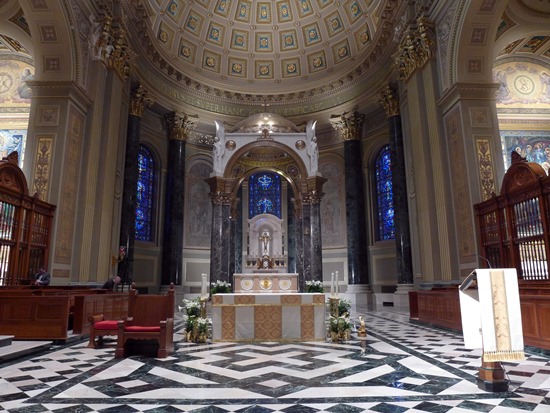
          The Cathedral Basilica of Sts. Peter and Paul was built from 1846 to 1864 on a Roman cross plan. The church was designed in the Roman-Corinthian style and modelled after the Basilica of Sts. Ambrose and Charles in Rome. A huge Renaissance vaulted dome rises 48 metres above the floor, enabling an undistracted and spacious nave. The highlight of the golden interior is the marble baldachin with a bronze dome above the altar, emphasizing the centrality of the altar and the Eucharistic sacrifice. Two large paintings are found in the transepts, depicting the Adoration of the Magi and the Ascension of the Lord.


          Philadelphia is the seat of two Catholic metropolitan sees: the Latin-rite Archdiocese as well as the Ukrainian Byzantine-rite Archeparchy (“eparchy” is an Eastern-rite diocese that is outside the proper territory of the particular Eastern Church). The large number of Byzantine-rite Catholics in the area is the result of immigration of many from Austria-Hungary in the late 1870s. The Byzantine Catholics were given an Ordinariate in 1913, until 1924 when it was ritually split into two apostolic exarchates of Ruthenian and Ukrainian rites. The latter was based in Philadelphia, and was promoted to metropolia in 1958.

          The Cathedral of the Immaculate Conception is modelled upon Hagia Sophia in Istanbul, the original patriarchal cathedral of the Byzantine empire. The dome is spectacular with golden paint from the outside, but looking from the inside is a mosaic of Christ Pantocrator. The wall in the sanctuary depicts the Theotokos (Mary the God-bearer). The four major icons on the lower level of the iconostasis (wall of icons separating the nave from the sanctuary) include St. Nicholas, the Mother of God, Christ the Teacher and St. John the Baptist from left to right.


          John Nepomucene Neumann was a Redemptorist priest from Bohemia (now Czech Republic) who became the Bishop of Philadelphia in 1852. The holy and frugal bishop was the first one in the country to organize a diocesan school system to care for the children. After his death in 1860, he was beatified during the Second Vatican Council and later canonized in 1977, becoming the first American male to receive this honour.

          The Redemptorist Church of St. Peter the Apostle in Philadelphia, built in 1843, is also the home of the National Shrine of St. John Neumann. His body as well as a museum showcasing his life can be found on the left side of the church. In 2009, a fire broke out, burning the pulpit to dust, but the body of the saint suffered no damage. Many consider this as a miracle.


          The parish of St. Rita was established in 1907 and was entrusted to the Augustinian Friars. The inspiration of St. Rita of Cascia, a 15th-century wife, mother, widow, nun and stigmatist, soon proved to be instrumental in caring for immigrant families. Many were drawn into devotion to the saint, who is the patron saint of the impossible causes, abused wives and widows.

          The shrine was designated a national shrine by the American bishops in 2003 “for its outstanding ministry and its effective service to the spiritual, liturgical and devotional life of pilgrims from across the United States.” Today, the National Shrine of St. Rita of Cascia still continues to provide for many needy families.


          The National Shrine of St. Katharine Drexel is located in Bensalem, 30 km away from downtown Philadelphia. It is contained inside the Motherhouse of the Sisters of the Blessed Sacrament, which was founded by Katharine Drexel. Mother Katharine worked hard for the Black and native people who suffered from prejudice and unjust laws. She died at the age of 96 in 1955.

          The remains of Mother Katharine lie under the main altar in St. Elizabeth Chapel in the motherhouse. She was raised to the altar by John Paul II in 2000, and is still the only canonized saint to have been born a United States citizen. The shrine was designated a national shrine by the USCCB in 2008.


          Old St. Joseph’s Church was the first Catholic mission in Philadelphia, founded by a Jesuit in 1729. The first chapel was built in 1733, and was replaced by a bigger church in 1757.

          The church is not easy to find because it is shielded from the street. This was for a practical reason to protect the church from anti-Catholic bigotry.


          Olde St. Augustine’s was the first church established by the Augustinian Friars in the United States in 1801. Even George Washington contributed to the building funds of the first church. The community founded St. Augustine Academy and became a famous musical centre in the 1810s. After being burnt down by anti-Catholic riots in 1844, the church was rebuilt in 1847.

          In 1976, St. Augustine’s Church was added onto the National Register of Historic Places. The church was also featured in the movie The Sixth Sense. The parish is now the home of many Filipinos.


          CubaWashingtonNew York CityPhiladelphia

          Photos: © 2015 Gabriel Chow
          Also posted on: Salt + Light


          2015-09-25

          New York City: Capital of the World


          Pope Francis has left the American capital for New York City, the second stop of the apostolic journey in this country. With less than 40 hours in the metropolis, the supreme pastor will have a packed schedule: praying with the clergy and religious, visiting the diplomats, praying at Ground Zero, meeting children and families of migrants, and celebrating Mass in Madison Square Garden. After New York City, the Pope will set out for Philadelphia, the last city in the trip.

          Pope John Paul II once told Cardinal John O’Connor, then Archbishop of New York, “I am only the Bishop of Rome, but you are the archbishop of the capital of the world!” This raised eyebrows among many, but it does have some truths to it. NYC is home to the United Nations Headquarters, and is arguably the world’s most important financial and cultural centre. New York City is also one of the strongholds of Catholicism, served by the Archdiocese of New York and Diocese of Brooklyn. The two dioceses are separated by the East River, and serve 10.73 million Catholics through 556 parishes.

          I enjoy New York City’s numerous beautiful architectural works, and churches of all denominations fascinate me too. The city hosts the greatest number of cathedrals in the world; visiting all of the 4 Catholic cathedrals (and a former cathedral), 13 Orthodox cathedrals and 1 Episcopalian cathedral in the city was a joyful yet tiresome experience for me. In this blog post, I will recommend noteworthy Catholic churches for pilgrims to this city.

          CubaWashington DCNew York CityPhiladelphia


          Situated prominently in the heart of midtown Manhattan, St. Patrick’s Cathedral is the exception to otherwise financial and business buildings. Shining in its pure neo-Gothic style, the white façade and interior have just been cleaned and massively restored, just in time for the papal visit. Construction of this new cathedral began in 1858, and only completed 20 years later due to the Civil War.

          The spacious cathedral can accommodate 3,000 people, with its spires rising rise over 100 metres. The two pipe organs contain more than 9,000 pipes and 206 stops. Four pre-Vatican II cardinals’ red galeri (former ceremonial hats with tassels used by clergy, presently still depicted in the coat-of-arms of prelates) are proudly hung in the ceiling of the cathedral, a popular custom of cardinalatial sees.

          St. Patrick’s is the only church in the Americas that has received a pope more than three times: Paul VI in 1965, John Paul II in 1979 and 1995, Benedict XVI in 2008, and Francis in 2015. It is also the first American church that a pope set foot in.


          The Diocese of New York was created out of the primatial see of Baltimore in 1808, along with Bardstown, Boston and Philadelphia. New York and Cincinnati became the third and fourth metropolitan sees of U.S.A. in 1850, after Baltimore and St. Louis did. Built between 1809 to 1815, Old St. Patrick served as the seat of the Bishop of New York until 1879 when the new St. Patrick’s Cathedral was dedicated.

          In 2010, the former cathedral was raised to the dignity of minor basilica, the 67th church in the country to receive the honour. Today, the Basilica of St. Patrick’s Old Cathedral serves people in downtown Manhattan of various cultures, offering Mass in English, Spanish and Chinese. This year, the church is also celebrating its bicentennial, with Cardinal Timothy Dolan presiding in the blessing of the newly restored basilica, to be held on November 22.


          St. Peter’s Church, established in 1785, is the first parish in the New York State before the state was admitted into the United States in 1788. This present church in Greek Revival style, situated in Lower Manhattan, was rebuilt from 1836 to 1840. It was here that St. Elizabeth Ann Seton converted from the Episcopalian Church in 1805.

          On 11 September 2001, located just 100 metres from the World Trade Center, the roof of the church suffered damage from the landing gear of one of the airplanes that struck the buildings. Fr. Mychal Judge, the Franciscan chaplain for FDNY (New York City Fire Department), was the first publicly identified casualty of the event when debris from the towers hit him. He preached to the firefighters the day before, saying, “No matter how big the call, no matter how small, you have no idea of what God is calling you to do, but God needs you… And this firehouse will be a great blessing to his neighborhood and to this city. Amen.”


          Despite the historicity of St. Peter’s Church (as it was rebuilt in 1840), the Church of St. Joseph in Manhattan claims the title as the oldest church in New York City. As the six parish in Manhattan, its church building was constructed between 1833 to 1834, also in the neoclassical Greek Revival style.

          The Dominican parish serves many students from the nearby New York University, and has been running a soup kitchen since the 1980s.


          Located within 200 metres of the headquarters of the United Nations, the Church of the Holy Family is popular among diplomats and officials of the extraterritorial jurisdiction. With the modern style in mind, the church was meant for the new liturgy and a spirit of ecumenism. On 4 October 1965, the church proudly received Pope Paul VI in an ecumenical meeting. This is also the first time that a Roman Pontiff visited a non-cathedral church on the American continent.


          The German Parish of St. Joseph, Yorkville, had its origin in 1873, at first served by the Jesuits. A new church was built in 1895 to accommodate the growing parish community. After Vatican II, many elaborate furnishings were unfortunately discarded, until the 1990’s when the interior was restored and refined. It received Pope Benedict XVI on 18 April 2008 for an ecumenical meeting.


          Across the Brooklyn Bridge, St. James, built in 1822, was the first Catholic church on the Long Island. It became the seat of the Diocese of Brooklyn when the see was established in 1853. It lost the cathedral status in 1896 only to regain it in 1972. On 3 October 1979, Pope John Paul II visited the cathedral. Three years later, it was given the status of minor basilica and is now known as the Cathedral Basilica of St. James.


          The first St. Joseph’s Church at this site was founded in 1850 to serve new immigrants in the city. It was rebuilt in 1912 in the Spanish Colonial style. When the Cathedral Basilica of St. James is too small to accommodate people for major diocesan liturgies, the Bishop of Brooklyn petitioned the Congregation for Bishops to have St. Joseph’s Church designated as a co-cathedral. The petition was granted in February 2013, and since then, St. Joseph’s Co-Cathedral is the venue for major liturgical events in the diocese.

          Each diocese can only have one cathedral, the symbol of the unity of the local Church. However, for various historical or practical reasons, some dioceses may have co-cathedrals. A co-cathedral has the privilege of a cathedra (the bishop’s seat) and can host the important pontifical Masses for the bishop. While the anniversary of the dedication of the cathedral is celebrated as a feast throughout the diocese, the co-cathedral does not enjoy such. (Co-cathedrals that were once cathedrals have special privileges of indulgences too.)


          Photos: © 2015 Gabriel Chow
          Also posted on: Salt+Light